Showing posts with label Delhi. Show all posts

Sunday, October 12, 2014

Delhi, Lost Monuments


LOST MONUMENTS OF DELHI

Delhi has been an epicenter of political powers since generations. It has seen the birth and fall of many rulers and hence the history of Delhi is so diverse. There are different versions of stories and facts about the history of Delhi. We don’t know which one is right. But one thing is sure and that is - Delhi has stood by the test of time. Like a Phoenix the city has risen from the ashes several times. Today it is one of the most developed cities of India. But in this course of development, there are lots of loss that city has seen. One of the losses is its lost monuments. There are some monuments that have been completely unknown to people. Lost amidst the hustle and bustle of this capital city, they are lying unnoticed.

      Old Fort
Let’s start with the Old Fort. Though Old Fort is not actually lost, I have included this fort in lost places as it is really underrated and unnoticed. Though located on Mathura Road, just next to National Zoological Park, which has huge influx of local people on weekends, the Old Fort is visited only by three kinds of people today. Firstly, couples who have made this place a dating spot (unfortunately), secondly by some locals who came here with their kids for an evening boating ride (in pond that is outside the fort) and thirdly people like me who loves to visit historical places. The saddest part of this fort is the couple visitors who have shamelessly made this beautiful historical place a dating spot. I wish government could do something about it. Anyways coming back to the beauty of this fort, it is spread over 2 kilometers and surrounded by green gardens. Build by Sher Shar Suri the fort houses- A lake, Stepped Well (Baoli), Qila-i-Kuhna Mosque and Humayun’s Library known as Sher Mandal. Though most of the structures are not maintained the green gardens are quite maintained. Most of the structures are closed and you cannot go inside, other than a small museum just beside the main gate. Thankfully every year, one or the other musical festival(s) are held here which invites decent number of visitors.


Khairul Manazil, a Mosque and later a Madarsa built by Maham Anga, stands opposite to the Old Fort. Lying unnoticed there, it is still surviving. It remains open for Friday prayers.

        Firoz Shah Kotla
Another beautiful ruin that has survived the course time is Firoz Shah Kotla monument. I know the world knows Firoz Shah Stadium, but only few have heard of this monument. But just beside this stadium lies the fortress built by Sultan Feroz ShahTughlaq. One can find the remains of the fifth city of Delhi, the Famous Ferozabad, at the Feroz shah Kotla near Bahadur shah Zafar Marg amidst New and Old Delhi. The Fort of Feroz Shah at Kotla was built by Feroz Shah Tuglaq in the year 1354. Like many other monuments of Delhi, it is lying there unnoticed.Unlike Old Fort it is visited by families. Originally it was a fortress built by Sultan FerozshahTughlaq to house his version of Delhi city called Ferozabad. A large enclosure of high walls, Feroz Shah Kotla was the grand and opulent royal citadel of the city. Many visitors like Timur and others have given splendid descriptions of this fortress. But unfortunately, most of its beauty is gone today.It houses Palaces, Pillared halls, a pigeon-tower and a Baoli (stepped well) some of which are still in good condition. But the two most interesting structure personally my favourite are The Jami Masjid and The Ashoka’s Pillar.


Beside these, the most interesting fact about this place is that people come here to light up diyas and incense sticks. It is considered as the abode of Djinns or spirits. I don’t know from where and when this belief has come into existence, but it’s very evident. Believers come here to ask for the completion of wishes.  Some people even leave written requests. The fixed stream of believers assures that wishes are being granted by the Djinns. This fort has also been mentioned in William Dalrymple’s books.
  

      Tughlaqabad Fort
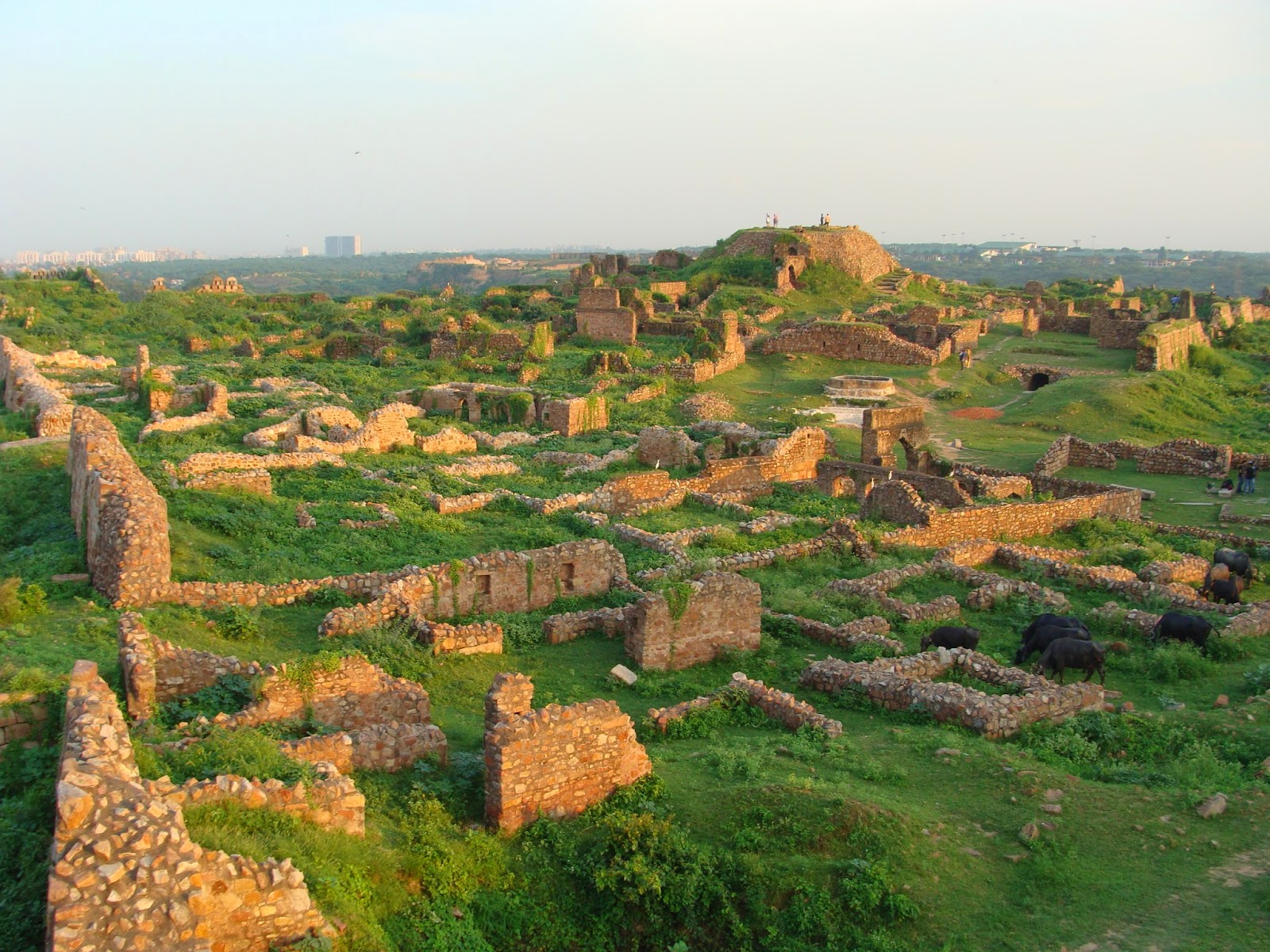
Lying in isolation, this fort is in an extremely deplorable condition. It’s crumbling, yet massive ramparts standing a silent witness to a change its builders could never have thought. The Tughlaqabad Fort was built by Ghiyas-ud-din Tughlaq, the founder of the Tughlaq dynasty. The fort is spread over an extensive area and a piece of architectural genius. I saw the walls of the fort when I was passing through that area and then I decided that I have to visit this place. Its architectural beauty is very well defined in William Dalrymple’s book (the famous travel writer).


Legend says that this place is cursed. For completing this fort Ghiyas-ud-Din ordered that all the workers of Delhi to work for this fort. This drew the rage of the Sufi saint, Hazrat Nizamuddin Auliya, who found work on his baoli (well) interrupted. And hence he cursed this fort, saying, “May the fort remain unoccupied, or else may herdsmen live here.”
True to this, today fort is just a mere ruin. 

      Safdarjung Fort
The fort’s architecture resembles the structure of Humayun’s Tomb. First time I went there was because it used to house the office of Archaeological Survey of India and had to interview an officer there. Till that time even I had no idea about this fort. Known as the “The Last Flicker in the Lamp of Mughal Architecture”, this monument is not visited by many tourists today as most of us don’t know about it. I am sure it is not even listed in many websites that show places to visit in Delhi. This magnificent monument was completed in 1754 as a memorial of Mirza Muqim Abul Mansur Khan, popularly known as Safdarjung by his son Nawab Shuja-ud-Daulah of Awadh. Located in the in the western end of Lodhi road, it is lying unnoticed there.


      Jamali Kamali

The Jamali Kamali mosque and tomb is located on the Mehrauli road. The mosque was built in 1528-29 during the rule of Babur. Named after the famous Sufi saint Jamali and his not so know disciple Kamali, this place is quite isolated. Other than the localites who came here with their herds and a guard, I hardly found anyone there. The most surprising story about this place is that it is haunted. Though I did not experienced anything like that. I only felt one thing and that was how badly this place has been ignored. 


Monday, June 24, 2013

India Gate and President House


India Gate and President House

When I visited Delhi for the first time, I thought India Gate is one of the most over-hyped places of Delhi. I have always been more inclined towards Mughal architecture. But after being a apart of this city and staying here for seven long years, my opinion about India Gate has definitely changed. India Gate is a 42-metre tall Gate that commemorates the members of the erstwhile British Indian Army who sacrificed their lives fighting for the Indian Empire in the Afghan Wars and World War I. Designed by Sir Edwin Lutyens, the construction work of India Gate was completed in the year 1931. And it is counted among the largest war memorials in India.


But India Gate is not just about this. It is a much more than its architecture and history. First and the most important thing about this place is that it is situated in such a way that many important roads spread out from it. The lush green lawns, the ice cream walas, balloon wallas and the fun-filled ambience makes this place one of the most sought aout places for family outing. Moreover it is one of the safest places in Delhi to visit in night. In fact I would say the only safe place in Delhi where you can enjoy the cool breeze with your family and friends late in the night. It is a perfect picnic spot.  The place is illuminated with thousands of lights and which adds up to its beauty. 


And if its a cool windy full moon summer night then your evening is bound to refreshing.

Off late India Gate has also become a unifying bond for Delhites. Either it is celebrating India's victory in cricket world cup or protesting against something wrong. It provides a perfect ground for unifying people of Delhi which is not very seen very often.


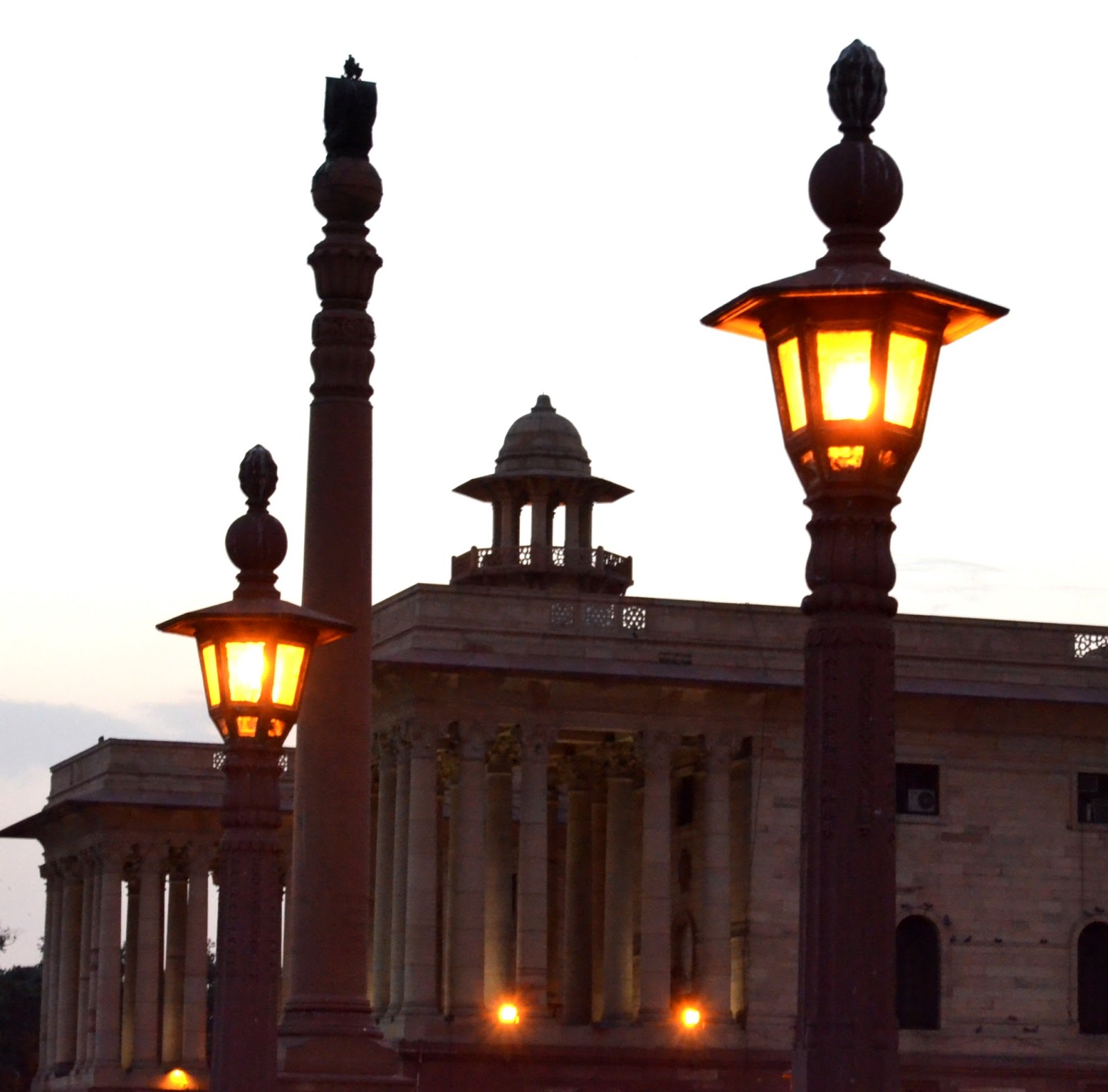
And just opposite to India Gate is the magnificent President House. It is one of the largest residential houses of any Head of the State in the world in terms of its magnitude, enormity and its grandeur. This spectacular piece of the British era was the residence of the Viceroy of India till the year 1950 and was known as the Viceroy's House. Also known as Rashtrpati Bhawan, it was designed by Sir Edwin Lutyens, a British architect along with Chief architect and Chief Engineer Hugh Keeling and many Indian contractors.


Today, the President House is surrounded by many guards and it is under strict surveillance. But I am sure anyone will be awe-struck by the architecture and magnificence of this bhawan.


Sunday, April 21, 2013

Abode of Spirits


Ferozshah Kotla


Today world know this place as a cricket stadium, in fact it is one of the esteemed international cricket grounds in India. But just beside this stadium lies the fortress built by Sultan Ferozshah Tughlaq. Like many other monuments of Delhi, it is lying there unnoticed. I had heard first about Feroz Shah Kotla through a television programme regarding monuments of Delhi and was quite fascinated by the myths and stories of this place.


Originally it was a fortress built by Sultan Ferozshah Tughlaq to house his version of Delhi city called Ferozabad. A large enclosure of high walls, Feroz Shah Kotla was the grand and opulent royal citadel of the city. Many visitors like Timur and others have given splendid descriptions of this fortress. But unfortunately, most of its beauty is gone today.

It houses Palaces, Pillared halls, a pigeon-tower and a Baoli (stepped well) some of which are still in good condition. But the two most interesting structure personally my favourite are The Jami Masjid and The Ashoka’s Pillar.

Jami Masjid was the largest of the seven mosques built in Delhi during Tughlaq's reign. According to Franklin who visited the mosque m 1793, it had four cloisters, the domed roofs of which were supported by 260 stone columns, each about 5m high. The centre of the courtyard lay under an 8m high brick and stone octagonal dome. Though none of it exists today, still the remains give a glimpse of its rich structure and an era bygone. A beautiful structure indeed and the most important fact about this mosque is that it is still functional. And one can offers prayers here.


The Asoka’s Pillar from the 3rd century B.C. rises from the palace's crumbling remains, one of many pillars left by the Mauryan emperor Ashoka. It was moved from Pong Ghati Ambala, Punjab (currently in Haryana) placed here in 1356.

Beside these, the most interesting fact about this place is that people come here to light up diyas and incense sticks. It is considered as the abode of Djinns or spirits. I don’t know from where and when this belief has come into existence, but it’s very evident. Believers come here to ask for the completion of wishes.  Some people even leave written requests. The steady stream of believers assures that wishes are being granted by the Djinns.


Thursday is the day when most people come with their petitions and leave offerings. Either it be the curiosity of people (like me) or the faith, whatever the reason may be, people do visit this place. But like many other places of it is lying there unnoticed and needs proper maintenance and repairing.

Tuesday, March 26, 2013

SAFDARJANG TOMB


SAFDARJANG TOMB

It happened on one boring Saturday afternoon. I was just browsing through the net and reading and a dear friend called up and asked me to meet. It was a perfect opportunity to do away with my boredom, so I asked her to come to Safdarjang Tomb. A place I have been planning to go for long. Like many remnants of Delhi, today Safdarjang Tomb is lying unnoticed in the western end of Lodhi road. I went there long time back to interview one of the archaeologist regarding Mughal architecture but could not actually visit the tomb. So, this was the perfect opportunity for me to plunge in.   


Known as the “The Last Flicker in the Lamp of Mughal Architecture”, this monument is not visited by many tourists today as most of us don’t know about it. I am sure it is not even listed in many websites that show places to visit in Delhi. This magnificent monument was completed in 1754 as a memorial of Mirza Muqim Abul Mansur Khan, popularly known as Safdarjung by his son Nawab Shuja-ud-Daulah of Awadh. Safdarjung was the prime minister of Muhammad Shah who was a Mughal emperor from 1719 to 1748. In fact, it was Emperor Muhammad Shah who gave him the title of 'Safdarjung'.

If you have been to Humayun’s Tomb, you can definitely find resemblance in its architecture.  Safdarjung's tomb represents the last phase of the Mughal style of architecture. The tomb of Safdarjung was built in red sandstone and buff stone. There are two graves here, one of Safdarjung and the other is of his wife's. The square central chamber of the mausoleum is surrounded by eight rooms all around. Since it is not much visited by people, it is quite peaceful as compared to other monuments of Delhi.


Today, though this monument is lying unnoticed, it is one of the beautiful reminisce of the royal Mughal era. And definitely worth a visit for all those who want to take a glimpse of   Delhi’s glorious past. 

Monday, December 26, 2011


Jamia Nagar


Jamia Nagar is a paradise for food lovers. Located in the South Delhi, the area has number of food outlets to catch up with friends and family. Since the area houses one of the most popular universities of the city -Jamia Millia Islamia, it is jammed packed up with students all across the year. Moreover, the college is surrounded by number of colonies that further adds up in the list of food lovers. Either it be the college students or families of the vicinity Jamia Nagar is a hot spot of food lovers.

Starting with Zakir Nagar, the busiest market of the area is one of the most popular spot for students. In the hush-bush of the by lanes of Zakir nagar lies many food outlets. Though you can see non-vegetable stalls after every two to three shops some of the famous outlets that has carved out a niche for themselves are-

1)      PURANI DILLI is one of the busiest outlets of the area. Renowned mainly for its non-vegetarian food, the restaurant is a perfect combination of good ambience and mouth-watering food. Either it is the variety of chicken/mutton dishes or the mouth-watering sweet dish popularly known as ‘firni’, all its dilicacies are worth relishing. This place is visited by families and students alike and cherished by all age-groups.

2)      MEER-Loved for its varieties of non-vegetarian biryani, the outlet is a paradise for biryani lovers. Sindhi biryani is the most famous delicacy of this outlet.

3)      DILLI NEHARI HOTEL -Known for its exotic range of nehari it is must go spot for all non-veg lovers.

4)      KAREEMS- One of the branches of most popular food chain- Kareems is located opposite New Friends Colony at the end of Zakir Nagar. Though it is basically a take away outlet its mughlai food is very popular for its exotic spices.

And talking on food cannot be completed without mentioning the community center popularly called CC in New Friends Colony just beside the Zakir nagar.

Community center or CC has something to offer for all either it be vegetarian food lovers or non-vegetarian food lovers. But the most popular food outlet of CC is Al-Bake that is famous for its exquisite and delicious shawarma, a fast non-vegetarian food staple that came from middle east countries.

From pizza hut to nerulas, community center has all.

And for vegetarians, Brijwasi, Aanand and Nathus are the best option in the center.

Wednesday, August 25, 2010

Rain

RAIN………..

Hailing from a small town rain has always been an experience to enjoy. The wait for rainy season, the closing of schools due to water logging, riding bicycle with sisters in my water logged colony and splashing water on each other to the celebration of savan festival in college and the most mesmerizing yellow lilies are some of the vivid memories I have of rain.

After coming to Delhi I realized that there is scanty rainfall here unlike my hometown. And it’s completely different here in Delhi, as I stand in my balcony with a cup of tea on Sunday evening to enjoy rain. I can hardly see the sky as the congested houses and long buildings are a common sight in most of the colonies of the city. The only thing I can see from my balcony is-  wet children in rain, enjoying among themselves fetching water in water gallons, (as water scarcity is common phenomena in Delhi). Boys riding bikes passing from one lane to another and the people standing in their small balconies and terrace are some of the common sight here.

But one thing is certain once in a while rain is certainly beautiful and a wonderful retreat from the frustrating heat of Delhi. The most fascinating is the morning after nightlong rain. The beautiful clouds of various shapes  are simply amazing. The swift and soft breeze touching the face gives a wonderful refreshing feeling. Just an auto rickshaw drive from home to office is also enough to enjoy the cool breeze on your face.

But this is not the only thing that I have to face while coming to office. Traffic jams, argument with auto rickshaw drivers are things that I cannot avoid even on this beautiful morning. But the clouds and cool breeze are worth enjoying. I just wish I could get a leave so that I can hang out somewhere - clicking photos and enjoying nature!!