Samarkand
Visiting Uzbekistan has been my
dream since many years, and with simplified visa process and travel ease the
dream came true last month. An
amalgamation of architectural splendor and rich cultural history, Uzbekistan is definitely one of the most beautiful countries in Central Asia.
Over the centuries, many powerful kingdoms like-Persian, Arab, Turkish, Mongolian, and Soviet have flourished and declined in this region, each imparting its own diverse influence on the art, architecture, and culture of Uzbekistan. The influence of different civilizations have shaped the culture of Uzbekistan and thereby creating an incredible mosaic.
We visited
Samarkand and Bukhara in this trip and one word to define these cities would be mesmerizing. They are some
of the oldest inhabited cities in the world. It used to be one of
the most vital knowledge exchange centers in the world, the stopover for
important literati’s, religious figures, traders and travelers in general, and
therefore it is dotted by many Madrasas- the Islamic school system.
Day-1 Samarkand- Registan Square,
Handweaving Silk Carpet workshop, Paper making Workshop.
We started our journey in Samarkand and stayed
there for 2 days. On our first day we visited the amazing Registan Ensemble, Handweaving Silk Carpet workshop and Paper making Workshop.
Since we went in off season in the month of August,
it was hot there. But as we have stayed in hot countries, we did not have
much issue with the climate. Though the days were hot, the evenings were quite
pleasant. Coming back to Registan Ensemble, it is easy to reach the place and the
best option to commute there was Yandex Taxi, it was affordable and convenient.
And if you are an architecture lover like me
you are going to simply adore this beautiful Registan Ensemble so much that I did
not want to leave it, even after it got closed. We got very little time there, as
it got closed early because they were preparing for International Music
Festival.
Popularly known as Registan Square, it is called it is the epitome of beauty. “Registan” in Uzbek means 'sandy place' and in ancient times this square was trade center for artisans and farmers and hence the name Registan. Much later these beautiful Madrasas were built. It houses three exemplary structures- Ulug Beg Madrasa, Tillya-Kari Madrasa and Sher-Dor Madrasa.

The Registan Square
It was late afternoon when we arrived the Registan Square, and I must say it’s easy to get lost in its grandeur. So, we opted for the guide, and she took us to all the three Madrasas and guided us with its information.
1. Ulug Beg Madrasa- Built by the grandson of Timur- Ulug Beg, this is oldest of the three Madrassas at the Registan Square. It was built between 1417 to 20 and since Ulugh Beg was an astronomer and mathematician, both these interests are reflected in the mosaic tile work with depictions of the sky and stars on the entrance arch. The glazed bricks create beautiful ornaments on the yellowish laying of the walls. It is said that it was the largest scientific-educational establishment in Samarkand. It has two stories where students used to come and seek knowledge. Here students were taught philosophy, astronomy, mathematics, theology. Today it houses museum.
 |
 |
2. Tila Lori Madrasa- This Madrasa is in the center of the square and was built by Yalangtush Bakhodur in the 17th century. The name translates to “decorated with gold”, for the gold details on the facade. Though the Tilla Kori is referred to as a Madrasa, it houses a Mosque and Madrassa both. The Madrasa gets its name from ‘Tilla Kari or gold-cover or gilt work’ in the mosque portion of the monument. The intricately decorated interiors of the Mosque were meant to symbolize Samarkand’s affluence. The Mosque displays a magnificent optical illusion as the ceiling is flat but designed and painted in such a way that it appears as a dome.

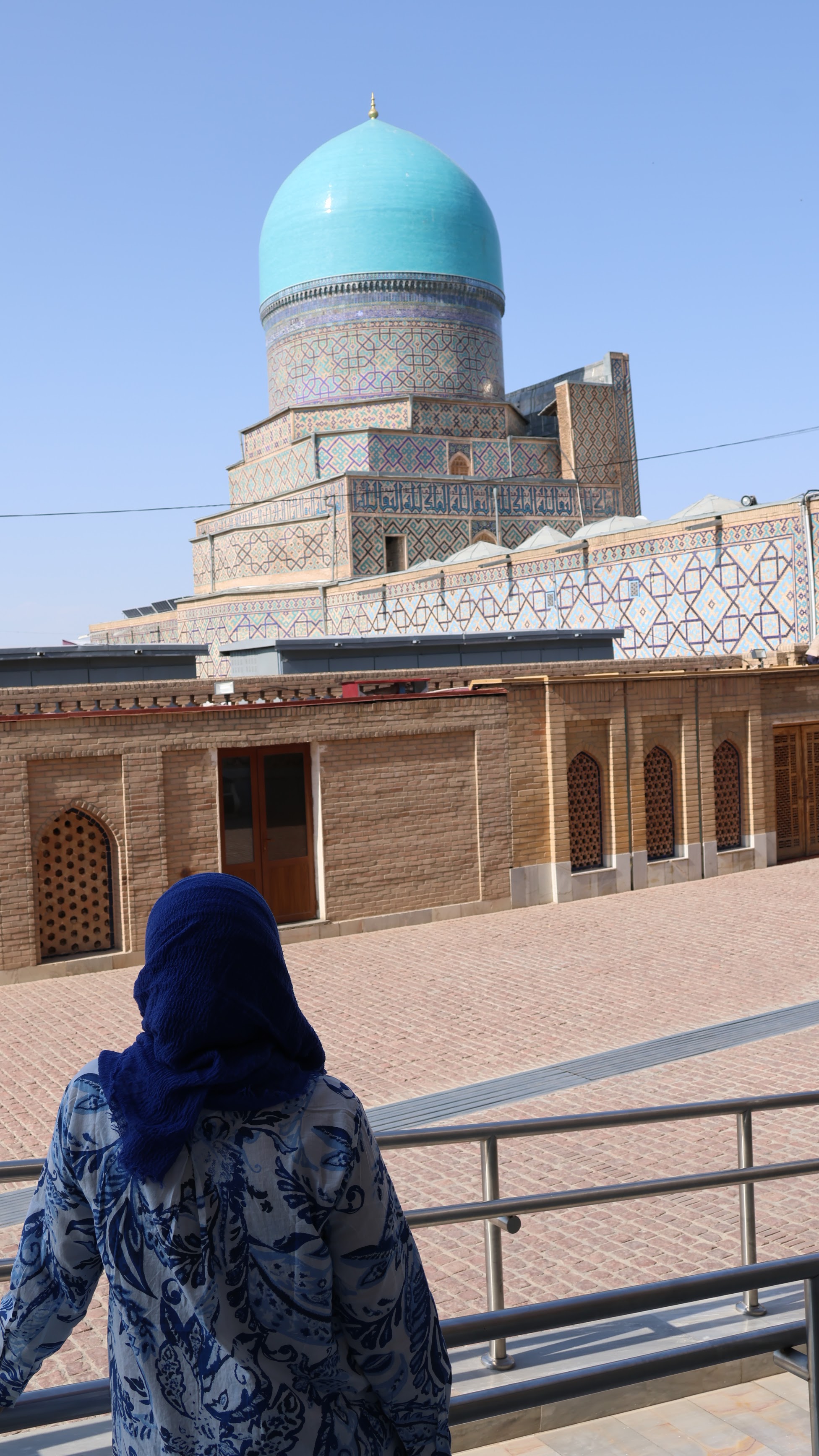
The exterior view of the Tila Lori Madrasa, the sky blue tomb is of the Tila Lori Moque
3. Sher Dor Madrasa- This is the third Madrasa of this square and named after the two big golden tigers carrying a sun on their backs and heading after white fallow-deer were adoring the entrance. Sher means tiger (lion) and the name is translated as “adorned with tigers”. It was this plot that later became a national symbol of Uzbekistan. Today it houses many shops of souvenir, silk scarves and other handicrafts.

The Sher Dor Madrasa, you can see the two golden tigers painted on it
The detailing and color of the
mosaic work of all the three Madrasas are so dazzling that it is easy to spend
several hours just wandering around this amazing square.
Then we visited the Handweaving Silk Carpet workshop where we got a glimpse into the traditional art of carpet production. Samarkand is a key city on the Silk Road and thus has a long history of silk weaving and textile artisanry. Most weavers in the workshop are women, which is symbolic.

Woman weaving the carpet
In the showroom, hundreds of
finished rugs and carpets are on display. It’s wonderful to watch the saleswoman
unfurl a shimmering roll of finely woven silk, then turn it around to show off
the “two-tone” quality much admired in top quality weaves.
Please do not fear that you may
be pressured into a purchase. That is not their way the people are in general
very hospitable and amazing.
Then we went to the traditional paper making workshop, which my daughters really love. It is a bit far from the city in the suburbs of Samarkand. But an operating paper workshop, where craftsmen revive year old paper technique.
We saw stages of paper production
using the same technologies and raw materials as hundreds of years ago. Those
who wish can even take part in the papermaking process.

Women shredding the wood, the first step of papermaking
The best thing to do in night
there was to visit Registan Square again by night. This Registan is lighted
beautifully and though we could not go inside in the evening because they were preparing
for the international music concert that was about to take place there, we admired
the place from outside.

Night view of Registan
We ended the day with the dinner
at Al Ikram restaurant known for its mouth-watering kebab, although language
can be a barrier as they could not understand English. However, the kebabs are
worth trying.
Day- 2- Siyob Bazar, Bibi Khanam
Mosque, Shahi Zinda and
Bibi Khanam Mosque & Siyob Bazar
We started our next day with the
visit Bibi Khanam Mosque, and we crossed the Siyob market. This bazaar is the
original remnant of the Silk Road. Inside the covered bazaar, we just strolled
out and checked out what was for sale. It had abundance of - fresh fruits, dried
fruits, nuts, vegetables, gift baskets, clothes, and flowers. But since we were short of time, we rushed to
Bibi Khanam Mosque.
The mosque, which could accommodate 10,000 worshippers and is named after Timur’s wife. The entrance of the Mosque is super grand. There seems to have difference in opinion of who ordered to build this Mosque. Some say that Timur ordered the construction of this Mosque after his successful campaign in India in 1398, as a symbol to depict his power. Other accounts have it that as Timur devastated Northern India, Bibi Khanam ordered the construction of the mosque to surprise the conqueror on his return to Samarkand.

But one thing is common in all the views and that is it is one of the the best
architectural beauty of Samarkand. It is also said that labor was brought over
from Persia and the best artisans labored to build the mosque. Additionally,
nearly 100 elephants were imported from Indian to haul the wagons laden for the
marble used in the construction of the mosque. It was a period when the official
distinctive style was developed in the architecture of Central Asia. Amir Temur
famously said: “If you doubt our greatness, take a look at our buildings.”

The tomb of Mosque
Though a large
part of the Mosque is in ruins today, the grandeur of its bygone time can be
well imagined. I wish the Mosque was functional so that we could offer our
Friday prayer there but as our guide informed us, in the era of
the Soviet Union, Russians prevented worshippers from using the mosque to
suppress religion and used the mosque as a stable and cotton market.

Neither of the two mosques was
open so all we could do was walk around the courtyard and take in the views.
Much later, a huge marble pedestal for the Quran, was built by Ulugbek, Timur’s
grandson.

Shahi Zinda
Then we walked to Shahi Zinda- a complex of mausoleums.
Shah-i-Zinda means Living king.
Just after the entry after taking few steps towards
the left there was a Women Prayer ‘s room, so first, I offered my Friday prayer
there. Then after climbing further stairs there was Shahi Zinda. As I
approached the top of the steps, I got a glimpse of what was to come. I could
already see the stunning tile work. Adjoining both sides were the mausoleums- separated
by just a few feet- it was an incredible sight to behold.

It is easy to get lost in these shades of blue and no matter how many photos I clicked I still feel that I cannot capture enough of its beauty. Each and every nook and corner of this mausoleum is adorned in shades of blue tiles.


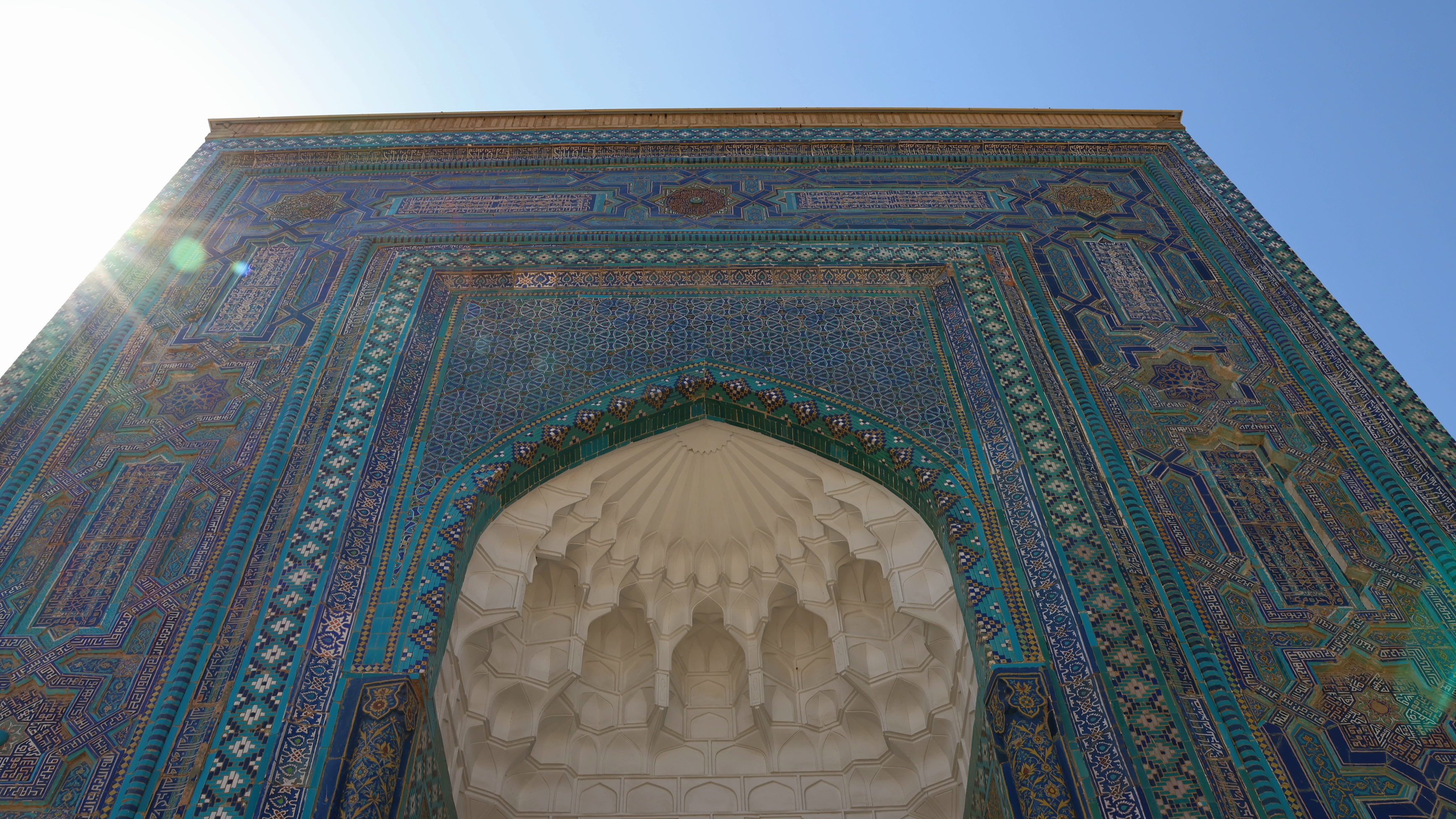
The beautiful embellished exterior
Kusum Ibn Al-Abbas Ibn Abd al-Muttalib, a cousin of Prophet
Mohammad (PBUH), brought Islam to Uzbekistan during the seventh century. He preached
Islam there and Shahi Zinda houses his tomb. And hence lot of tombs are there
as the vicinity is considered pious. The Timurids then continued to build their
royal tombs surrounding the scared site during the 14th and 15th centuries.

Outside the tomb of Kusum Ibn Al-Abbas Ibn Abd al-Muttalib
Gur-e-Amir
We ended our day with the visit
to - Gur-e-Amir. The name "Gur-e Amir" translates to "Tomb of
the King" in Persian as it houses the tombs of Timur, two of his sons and
two of his grandsons. It welcomes its visitor with a beautiful turquoise- blue
entrance with muqarnas/honey comb.


On either side, tall minarets
decorated in blue, glazed brick provide the perfect balance. The aesthetics symmetry,
cylindrical dome and tall minarets are said to be the inspiration for later
architecture in Agra and Delhi. It also has courtyard and further inside there
are separate rooms for tombs. And at the back of the Mausoleum few steps down
there is a beautiful souvenir shop filled with hand paintings and beautiful artifacts.

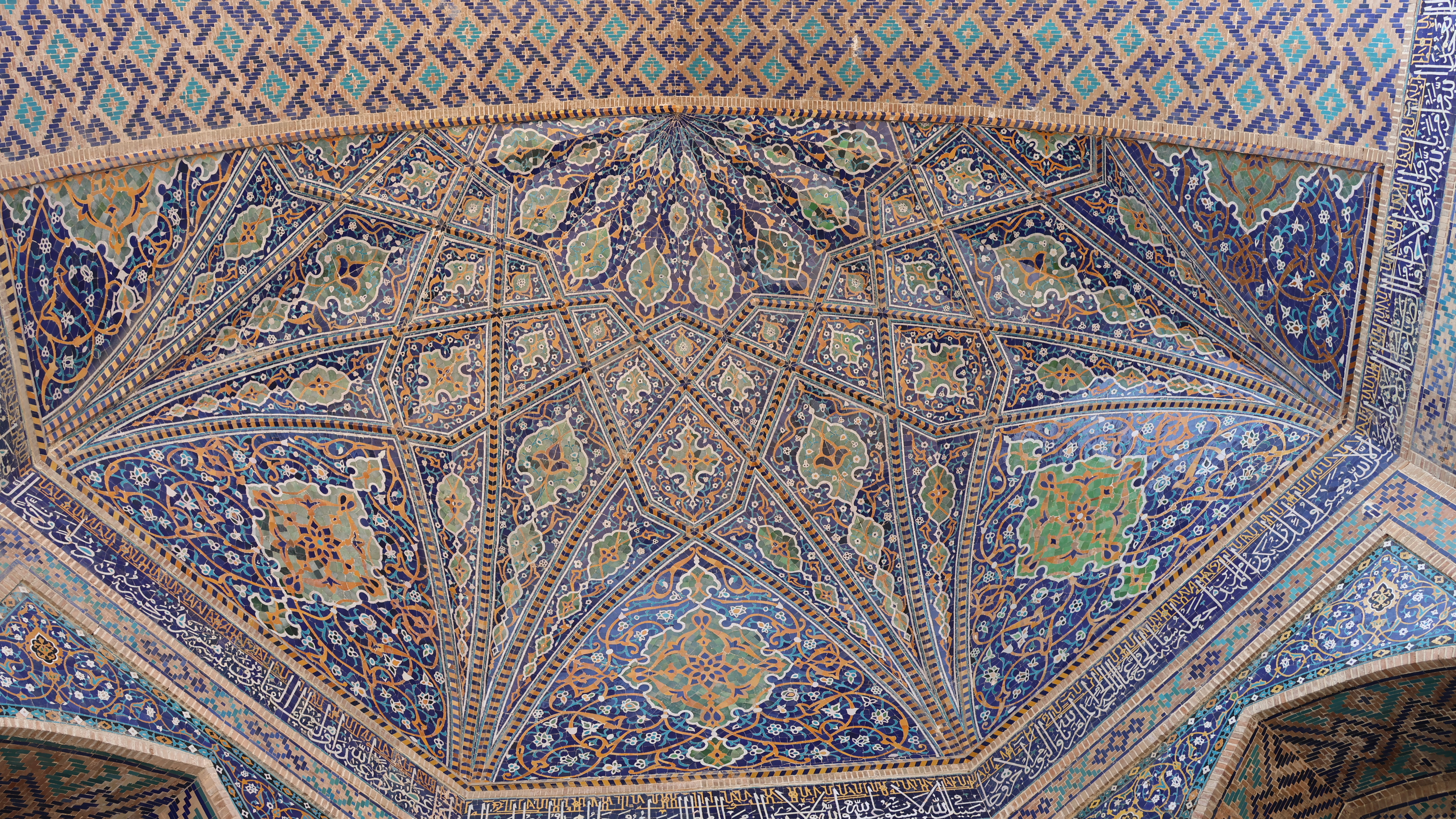
The ceiling of the mausoleum of Temur
Surrounding the mausoleum are the
ruins of walls that once held a Khanaka (hall with meeting rooms) and a Madrasa.
It looks even more beautiful when lights come out in night.

So after spending tiering yet amazing
day we headed to eat in restaurant which according to me is the best restaurant
of Samarkand. The name of the restaurant is very easy to remember as it is
called “Samarkand”. The food is delicious there and the décor is also worth visiting.

The interior of the Smarkand Restaurant , inside this there are three dining halls
Though there were more places to see in Samarkand like Ulug Beg Observatory, Museums etc, we could not go there because we headed to Bukhara next day.
And in the end I would like to conclude with what Alexender the great said when he conquered Samarkand - ‘Everything I have heard about Samarkand is true, except that it is much more beautiful than I imagined’.
SOME IMPORTANT FACTS
- The people in general are very helping and cordial, always ready to help.
- Uzbekistan has removed its visa
requirements for over seventy nationalities now. Citizens of UAE, Europe,
Australia, Canada, New Zealand, and many more can travel in Uzbekistan for 30
days without a visa.
- Best time to visit are April to June
& September -October. Although we visited there in August
- The best and most enjoyable way
to travel around Uzbekistan is by train as they’re comfortable and very
reasonably priced. The Afrosiyob trains are best and I would
advice to go and take the tickets directly from the station.
- Smarkand had very well developed roadways so commuting within the city is very convenient. For commuting with the city
Yandex Taxi is best, reasonable and easily available. You can simply download the app.
- Don’t forget to take travel
adapter for charging your phone (Type C and F plugs)
- Western toilets are available
everywhere but if you are used to of jitter like me then I would advice you to
carry portable sprayer.


