Sunday, October 27, 2013

Being a Bihari

Yes, I am a Biharan and I am proud of it!


I was taken by a shock when I realised what people of metros think about Patna, Bihar. I realised that the wrong perception about my home city (my state) is exaggerated to a great extent.

I still remember my first encounter with the outer world, the world outside my city. I was in my second year of graduation and I went to Mumbai, the city of dreams for my internship. This was literally my first exposure to the world, the real world. Professionally definitely I was growing every day but there were few things that really made me think about the misconceptions that people had about my home town- Patna.

The one very common thing that Mumbaikars in general ask to a non-Mumbaikar is- “You belong to which village?”(Kaun se Gaon se ayya/aayi?) I replied very firmly the first time I was encountered with this question- ‘I said I am from Patna and it is not a village’ and the answer I got was “Oh anything outside Mumbai is a village”. There were many events and conversations that I encountered where I have to explain about Patna, Bihar. Most of the times I get into an argument or discussion or sometimes people just listen to me without answering. There are some questions that shocked me a lot. One day while sitting for lunch in my office a colleague of mine asked- “How can you talk in English, I have heard that you belong to Bihar, 
Biharis don’t know English then how come you can talk in fluent English.” I took few seconds to make myself cool before answering. He seemed shocked to know that we have English medium schools and colleges there. He listened to me as if I am saying something out of the box. Another colleague popped in and asked- “So do you have computer and internet there? I have heard there is no electricity there?” Initially I was taken by a shock when I heard questions like these. But later I became very prompt in answering these questions. Another very common comment I am always given is- You don’t look like Bihari and I smile and say- why does all Biharis have horns?

When I moved to Delhi in 2007, I realised the situation here is sadder. The Delhites have even more negative stereotyping for Biharis. This is worse than the Mumbaikars. In Delhi ‘Bihari’ is used as slang. My fight with all those stereo typical presenters is still on. Even after staying in Delhi from last six years, I am often encountered with one of these kinds.   


Bihar is more about Lalu Prasad and crime stories. One very funny incident happened- a senior of mine asked me mockingly-“So you are a Biharai, can you say something in Bihari?” And I replied obviously Bihari is not a language, it is just a dialect. And all Biharis do not speak Bhojpuri.” Most of the people in Delhi make fun of me when I refer myself as ‘hum’ instead of ‘main’. We do say ‘hum’ to represent our self in place of ‘main’, that’s just because being from the rich cultural land of great kings of medieval India we used to treat ourselves with respect and it just came to our accent. With time, I have evolved myself and now I know how to answer whom depending upon the kind of comment one gives to me or Biharis. 

PATNA


Nostalgia


Nostalgia is what I felt, when I went to my home town this time. Having lived away from my home town for so many years, I was super excited to visit it this time. Here are the most nostalgic scenes of my last visit to Patna.

I went to my city after two long years. I got a chance go to the colony where I spent most of my childhood times. This is the place where I learnt to ride bicycle, scooty. These are couple of lines that I wrote-

Revisiting the memory lane
Terribly missing my childhood lane…
Never knew time will fly by
Leaving me wondering why
It was a different world
Full of happiness around

The memories are very vivid
In my heart and mind
The streets with Amaltas and Gulmohar tree
All the neighbours knew me

This is the place I learnt to ride bicycle and scooty
This is the place I learnt to enjoy rain and natural beauty
This is the place I learnt to tie my shoe laces
This is the place I learn to find hiding places

Imagining figure in cloud was most enjoying
Playing with my cats was most satisfying
Nostalgic is what I feel here
Imagining what all I left here

Revisiting the memory lane
Terribly missing my childhood lane…


My collage, school, lanes of my colony where I used to ride my bicycle, every visual of those golden times just came flashing by. There are some good, some bad and some amazing memories that I have. Now everything looks like a dream, a faded memory. I was going crazy at the sight of my colony, my old house, old school buildings, and the most beautiful house of my colony (which I thought I will buy once I will grow up).  Fortunately I found the same phuchka wala who use to come to my school. Once we laughed at him when he referred phuchka as water balls. But today when I saw him I felt overwhelmed. Time has changed him; he looks much older now. I ate phuchka in contentment and stood there for some time. My cousin thought I am gone crazy. But that moment was beautiful. There are very few things of my childhood that is still intact (other than my memories). My school has been shifted to a new area, the house where we lived for a very long time is no more there, it is replaced by an apartment and the tree from where we plucked guavas have been cut down.

Coming back to the purpose of my visit to my home town- I came here to attend the marriage of my cousin. And besides the usual get together and laughter sessions with my cousins and aunts, one very distinctive part of this visit was the time after Nikah (the marriage). The ceremony was organised in a different way this time. Nikaah in a very simple way was followed by a grand party. So all the male members of the family went to the Masjid for a simple Nikah. When they came back after nikah from phulwari, there was the same commotion, the same discussion, like the when they (my father, uncles and cousins) use to come back after nemaz of Eid. For some time I felt so overwhelmed by this scene that I stood there like a statue looking in that hall. The movement was exactly same, it seemed even after so long we are still the same old family. Every Eid, all my family members used to come to my paternal house to celebrate the festival. All my uncles and brothers use to go to Masjid decked up in freshly ironed and scented white kurta pejamas to offer Eid’s Nemaz. And when they came back after offering the nemaz we the ladies party were also ready deked up in new salkar kameez and bangles. That was how we celebrated Eid. That time Eid meant get together, happiness, fun, discussion, food. This marriage was a great get together for all of us. My uncles (my chachs), my aunts (my buas), and my cousins everyone was there. The only distinct person who was missing from the scene was my Amma (my grandmother). I knew that she cannot come back; it has been ten long years since she has left us. But I must say after she passed away we have not celebrated any Eid the way we used to.


Getting back to the marriage ceremony, I felt loved, appreciated and most importantly I was with my roots, my family, in my home town. Though three very important cousins could not make it to the marriage because they were not in India, still there were many people whom we knew. I met lots of relatives whom I have not met in years some recognised me and some did not. But the feeling was definitely super. My uncle (Chacha, father’s youngest brother) called me CHAMMO. In fact he called all of us (We three sisters) Chammo. In fact it was after a long time that we three sisters attended a marriage ceremony together. As a whole the whole ambience was amazing.  I don’t know when will the next occasion like this is going to happen in my family, but this visit of my home town was simply wonderful. Family get together, marriage function, a brief visit to my old colony, everything was simply nostalgic!


Sunday, September 8, 2013

Gwalior


The moment I saw Gwalior Fort’s photograph in a travel magazine, I wanted to visit it. Though I got the chance to visit this city recently only. Located at 122 km south of agra and 423 km north of the state capital Bhopal, the small city of Gwalior holds a strategic importance in history..

The Gwalior Fort


Aerial View of Gwalior Fort

The frontal View of the Fort

The motive of visit has been simply to explore the fort, but I ended up captivated by the interesting details of the city. Lets start with the iconic Gwalior Fort first. Rising 300 feet up, the fort is the second largest of such a style, first being the Chittorgarh fort in Rajasthan. The Mughal emperor Babar has termed it as "the pearl amongst the fortresses of Hind." Within the fort you will witness marvelous examples of medieval architecture. As we ascended the steep road going upwards towards the fort, we saw an array of amazing statues of Jain Tirthankaras, carved into the rock.

Statues of Jain Tirthankaras

The fort has been basically divided into two parts - one is well-maintained, while the other being untouched. It has been constructed during the 15th century by Raja Man Singh, who belonged to the Tomar dynasty. There are a number of historic buildings inside it, such as - Man Mandir, Gujari Mahal cum museum, Teli-ka-Mandir Temple and many others.

The Bahu Temple (Of Saas-Bahu Temple)

The Saas Temple (Of Saas-Bahu Temple)

The Teli-Mandir

The Man Mandir Palace is considered the most beautiful of all. It is elaborately constructed with an amazing structure that seems to hang on at the edge of the fort. Blue ceramic tiles form the façade of its walls. The Gujari Mahal is another magnificent palace, built as a dedication to the queen Mrignayani by Raja Man Singh Tomar.

The Man Mandir Palace

The Man Mandir Palace

The Man Mandir Palace

The Man Mandir Palace

The Man Mandir Palace

There are two levels down the fort that has been well preserved and allowed to visit, but it’s better to hire a guide for it. On the first level, you will find the Queen’s chamber with an ancient telephone. According the guide, this telephone has a hollow pipe that connected it to the other part of the palace, acting as a medium of communication between the queen and the king. I have no idea how true this story is but indeed, there exists a hole with a hollow pipe where the sound echoes. Apart from this, we also saw an ancient cooler in the room. On minus two level there is a place called Jauhar Kund where supposedly ‘sati-pratha’ was performed by the womenfolk of the royal family. This pratha was initiated when the king of Gwalior was defeated in the year 1232 AD. Legend has it that when kings used to die during a battle, their queens used to commit suicide in Jauhar Kund.

Jauhar Kund (Now covered)
The ancient telephone

The way to basement

The sound and light show at the Man Mandir Palace should not be missed. The eloquent narration of the story is done by Amitabh Bachchan – the Gopachal, sutradhar (narrator). But unfortunately we missed it because of heavy rain in the evening.

The Karan Palace, the Jahangir Mahal and the Shah Jahan Mahal are also worth seeing, though they are not well-maintained. In fact I was really sad at the condition of these palaces. If maintained in a proper way they are bound to look wonderful.

The Karan Palace

The Jahangir Mahal

The Jahangir Mahal

The Shah Jahan Mahal

In the vicinity you will find Saas-Bahu temple and Teli-ka Mandir, which are simply beautiful. The detailing and the splendid interior are spell bounding. The plus point is that you can see a bird’s eye view of the whole city from these Temples. A large part of this fort is under Scindia School premises. Established in 1897, this school one of the prominent boarding schools of India. It was originally started for nobles and princes and housed in the erstwhile barracks of the British soldiers.

Another attraction of this city is the Jai Vilas Palace - a museum which houses the royal artifacts. It is famous for its rich collection, ranging from manuscripts, miniature paintings, weapons, sculptures to coins and other various items. I say, definitely worth visiting !

Outside the Ghaus Moihammad Tomb

Tansen - the musical genius and one of the nine gems of the king Akbar’s court, was buried in this city. His memorial situated near the tomb of Ghaus. The ‘Jaali’ work in the courtyard around the tomb is spectacular. You will experience a calm ambience while the attractive architecture steals your heart.

Through a JALI of the courtyard of tomb

The JAALI Work
The exterior of Ghaus Mohammad Tomb

SOME OTHER FACTS ABOUT THIS CITY

It is believed that Gwalior was among the five princely states which enjoyed 21 gun salutes during British rule. Along with Hyderabad, Mysore, Jammu and Kashmir and Baroda, Gwalior held important stature within British India.

Gwalior is the headquarters of Chambal region and a major industrial and commercial region. Often referred to as the tourist capital of Madhya Pradesh, Gwalior is the fourth largest city of Madhya Pradesh and an educational hub.

Gwalior is famous for music - one of the oldest gharanas or schools of Hindustani classical music. Sarod Ghar, the first ever museum is dedicated to Indian musical instruments is located in this city.


Gwalior is famous for its handicrafts and leather products all over India.

LOCATION

Situated 197 meters above sea level, Gwalior is 121 km from Agra and 321 km from the national capital of New Delhi. Several trains are available from Delhi to Gwalior and the city is well-connected through road ways as well.


Saturday, August 17, 2013

LUCKNOW

LUCKNOW- The City of Nawabs

I thought I will not write this post until and unless I visit this city completely. But I could not stop myself. Moreover, this is the only city I visited this year. Popularly known as the City of Nawabs, Lucknow is definitely in my list of places to visit in India.  But I did not go there to visit the place as such. I went there for some other purpose, but managed to get glimpse of some of the famous places there. I will go there again and write another detailed post on the city. But till that time I will just jot down some great things about this amazing city.

The Railway Station of Lucknow

The city is a perfect mixture of tahzeeb (cannot find an English word that is closest to it) and modern amenities. There is a thahrav (stability) in this city and at the same time it is not like any other small city of India. What makes this city a worth visit is- its distinct monuments, royal cuisines and the historic buildings. The two great places that I managed to visit in my short span of time I was there was- Bara Imambaara and Chowk.

The Asif Mosque

The Asif Mosque


Built by Asaf-ud-Daulah, Nawab of Lucknow in 1784, Bara Imambaara is also called the Asaf Imambara. Blessed with beautiful architecture, it is supported by a Mosque and Baoli in its left and right. But the most interesting part of this monument is that it was build as a part of a relief project for a major famine that took place in the year 1784.

The Bhul Bhulaiya inside the Bara Imaambara
The Bara Imambaara is known for its incredible maze called Bhulbhulaiya. This is located in the upper floor of the monument. A stairway leads to this level. One can view a scenic panorama of the city from the top of this monument, which is absolutely breath-taking. The Bhulbhulaiya is a must see and the best way to find your way out without getting lost is by hiring a guide. It is said that great treasures are hidden in these secret tunnels of this maze. The monument remains open from morning 6am to evening 5pm.

Entrance of Bara Imaambara

The two inseparable part of this amazing city is- its Chikan Embroideray and Tunday Kabab. Good quality textiles with exquisite form of embroidery can be purchased from the city and I definitely grabbed the chance and bought kurtas of Chikan from Chowk. Chowk is a local market in Lucknow known for Chikan shops. Tunday kabab is something I just loved hogging. But unfortunately I could not have it because of lack of time. So, next time whenever I will go there I will make a proper plan and then visit the whole city properly. So, till then I will try to be satisfied with my short trip.

Monday, July 29, 2013

Alwar

Alwar, Rajasthan

It was an unplanned trip. We just thought to take a day off and go somewhere. I had a busy day at office so could not plan anything substantial. And without any planning we just headed to Alwar. Though the trip did not proved that wonderful to write about it, but still I thought before I forget it I will just jot down the things that I liked there. First of all Alwar is not that a great place to visit from the point of view of a tourist. But there is something worth visiting everywhere and hence this post.


Alwar is considered as the gateway of Rajasthan. It is very easy to reach there as it is just 160 km South from Delhi. And the road that connects Alwar from Delhi is in good condition. The only place to visit here is the Bala Fort also known as the Alwar Fort. 


The way to the fort is very interesting. We enjoyed the beauty of Aravalis hills on our drive to the fort. Beautiful peacocks are also in abundance to welcome the tourists at every turn.


Don’t expect it to be a great fort, like many other forts of Rajasthan. Most of the structures within the ramparts lie in ruins; the remains are also very simplistically maintained. And a special permission is required from the Superintendent of Police, Alwar to visit the place.

Monday, June 24, 2013

India Gate and President House


India Gate and President House

When I visited Delhi for the first time, I thought India Gate is one of the most over-hyped places of Delhi. I have always been more inclined towards Mughal architecture. But after being a apart of this city and staying here for seven long years, my opinion about India Gate has definitely changed. India Gate is a 42-metre tall Gate that commemorates the members of the erstwhile British Indian Army who sacrificed their lives fighting for the Indian Empire in the Afghan Wars and World War I. Designed by Sir Edwin Lutyens, the construction work of India Gate was completed in the year 1931. And it is counted among the largest war memorials in India.


But India Gate is not just about this. It is a much more than its architecture and history. First and the most important thing about this place is that it is situated in such a way that many important roads spread out from it. The lush green lawns, the ice cream walas, balloon wallas and the fun-filled ambience makes this place one of the most sought aout places for family outing. Moreover it is one of the safest places in Delhi to visit in night. In fact I would say the only safe place in Delhi where you can enjoy the cool breeze with your family and friends late in the night. It is a perfect picnic spot.  The place is illuminated with thousands of lights and which adds up to its beauty. 


And if its a cool windy full moon summer night then your evening is bound to refreshing.

Off late India Gate has also become a unifying bond for Delhites. Either it is celebrating India's victory in cricket world cup or protesting against something wrong. It provides a perfect ground for unifying people of Delhi which is not very seen very often.


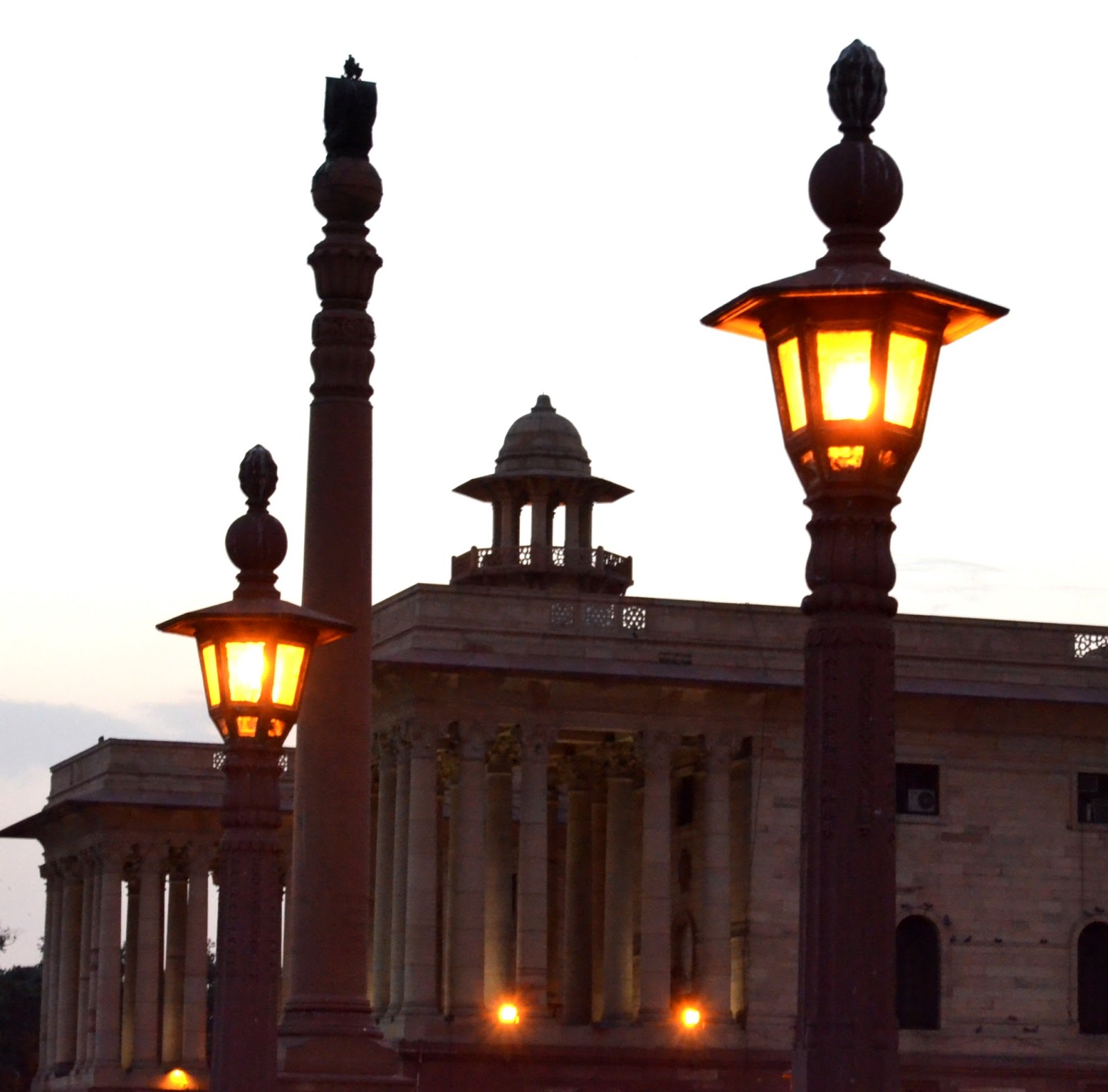
And just opposite to India Gate is the magnificent President House. It is one of the largest residential houses of any Head of the State in the world in terms of its magnitude, enormity and its grandeur. This spectacular piece of the British era was the residence of the Viceroy of India till the year 1950 and was known as the Viceroy's House. Also known as Rashtrpati Bhawan, it was designed by Sir Edwin Lutyens, a British architect along with Chief architect and Chief Engineer Hugh Keeling and many Indian contractors.


Today, the President House is surrounded by many guards and it is under strict surveillance. But I am sure anyone will be awe-struck by the architecture and magnificence of this bhawan.


Saturday, June 8, 2013

NEEMRANA FORT

If you tiered from your fast paced life and need a rejuvenating trip? Try out Neemrana Fort. Two words that define this fort perfectly are- picturesque and peaceful. The lush green lawns and the peaceful ambience is something you are bound to love here.

It is a perfect weekend getaway for all those who are living in Delhi/NCR. And therefore, it was a good option for us to spend a weekend there. The fort is around 130 kms from Delhi on the Delhi Jaipur highway. We left home by 7:30 am and reached there in three and a half hours. The road all the way is in a good condition so we were fresh when we reached there. As soon as we reach there, we found a vintage car parked on its entrance welcoming us (visitors).


We climbed a few levels through the ramped pathways which are surrounded by walls embellishing the various artefacts from the ear gone by. Since I am fond of forts and historical places, it is needless to say that I liked this place instantly. And since it has been turned into a heritage property it is maintained in a much better way than many other forts.


The fort was built in 1464 on hill across 6 acres of land. As per the officials here, it was in a state of degradation for a long time and it was only in 1986 that the fort was acquired for restoration.  Today, it is very well restored and beautified and one of the most sought after weekend destinations. It has a number of options for rooms and comprises of an open air swimming pool (decent size), a restaurant (afternoon and evening buffet service) and a spa. Since there is nothing much to eat in the surrounding area, you are somewhat compelled to eat in the hotel restaurant.


And if you have a knack of adventure then you can go for Flying Fox and enjoy the aerial view of the fort. Personally I am scared of height so I opted to enjoy the fort from the hill only. We explored every part of the fort. We relaxed in the lawn of Neemrana fort while I tried my hands on my not so good photography. Overlooking the Neemrana town, we sat in the view and enjoyed the breath-taking view. Moreover, view of the Aravali Hills from the resort is very clear. The rooms are decorated and furnished with traditional and colonial furniture, antiques and many objects of art.

Overall, Neemrana fort is an amazing example of heritage that is not only restored and preserved, but is also well- marketed to sustain itself. I wish there are more restoration happening like this in forts of India so that they can be well-preserved.