Saturday, November 30, 2013

Jaipur, Rajasthan


JAIPUR- The Pink City


Like my first trip to Jaipur the second and third trip was also unplanned. Popularly known as the pink city, it is just 250 kilometers from Delhi and therefore one of the most favored weekend destinations for Delhites. I have been there twice recently and once two years back so this blog post has been pending since a long time. Rajasthan being my favorite place to visit I definitely don’t mind visiting its capital city number of times. After visiting Jaipur, Jaisalmer, Ranthambore and Mount Abu are the only three destinations of Rajasthan where I still need to visit.


I am biased towards Rajasthan as a state. One reason is definitely their welcoming attitude and humbleness. The other reason for me being in love with this colorful state is its forts and palaces that are quite well-maintained. I have already been to Jodhpur, Udaipur, Bikaner but after visiting Jaipur I realized that the capital city is different from the other cities. Obviously being a capital, Jaipur is much more developed than the other cities. And moreover you can find lots of Delhites if you are there on weekend. My trip to this city was completed in three visits and hence this post will have photos of two qualities- one of a simple digital camera and one of a DSLR.


This city is a gem in the crown of royal Rajasthan. It is the best showcase of the magnificent grandeur that Rajasthan is famed for all over India and the world.

It is nearby to Delhi (NCR). The highways are pretty decent (other than in rainy season) and hence it is easy to drive. But you can also take a deluxe bus or a Volvo from Delhi which is easily available even if you plan a last time trip like me. Trains are also available but for that you need to plan in advance otherwise it is quite a busy route.

From the feedback the received from my last posts, I decided to divide my post into three parts-
  •         Places to visit in Jaipur
  •         Places to shop in Jaipur
  •       Must try food

Coming to the places to visit, I would say there are lots of places to visit here if you are fond of forts and palaces. And I being a lover of forts and palaces just love this place. You can easily divide your days here for a planned visit otherwise you are bond to miss out one or the other places of visiting here. But before starting your journey you must carry loads of water, a comfortable pair of walking shoes, hat, sunscreen lotion and sunglasses.

Day 1- You can start your visit with the most famous Amber Fort. Located on a hill which is 11 Km away from Jaipur, this fort is known for its unique artistic style, blending both Hindu and Muslim architecture. The Fort imposes rugged structure from outside ornate and lavish interior. The fort houses lots of sub-halls and palaces.


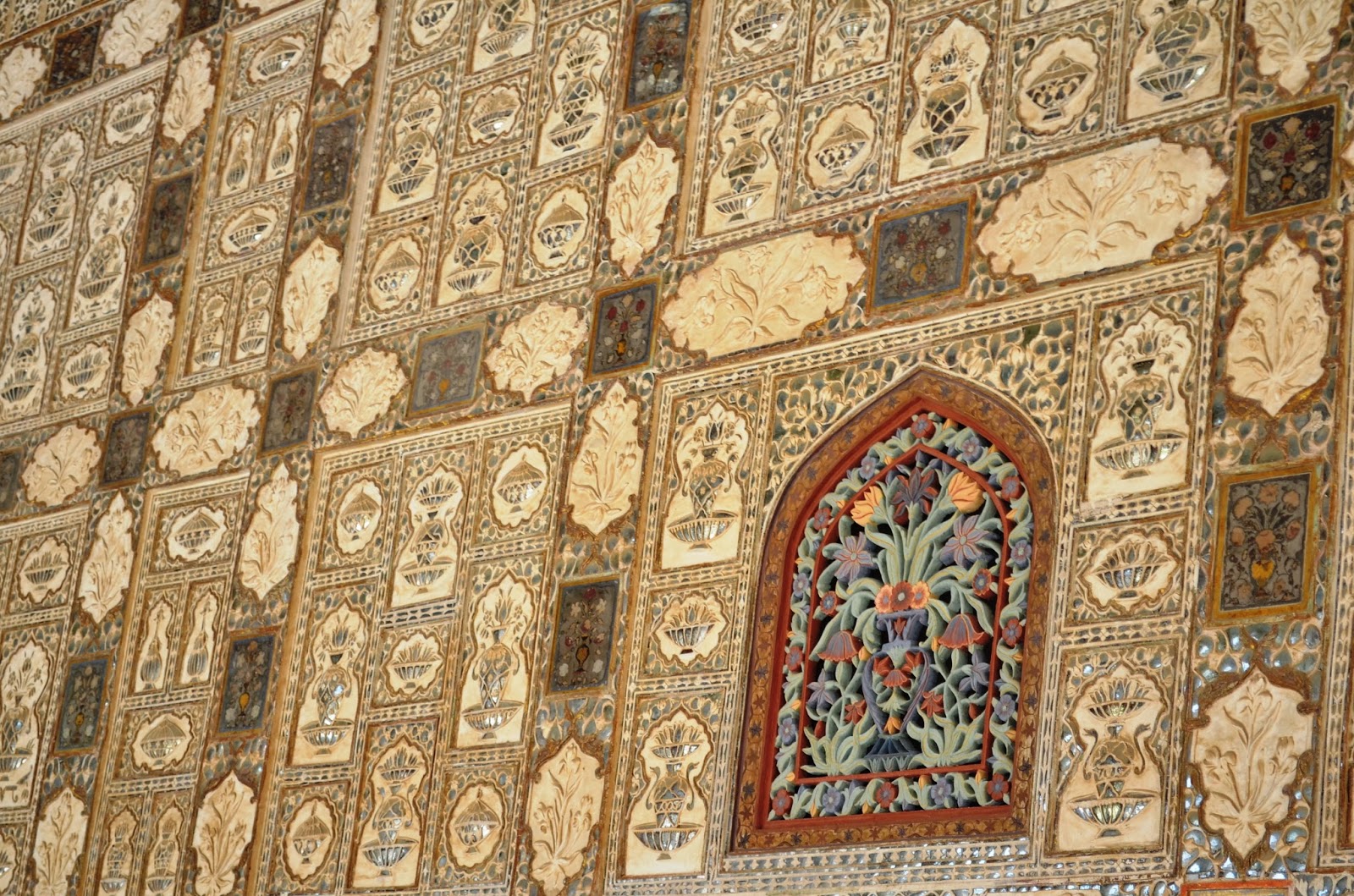
This royal fort houses- Diwan-e-Aam meaning the "Hall of Public Audience", the Diwan-e-Khas means the "Hall of Private Audience", the Sheesh Mahal (a beautiful mirror palace)/ Jai Mandir, and the Sukh Niwas where a cool climate is artificially created by winds that blow over the water cascading within the palace. The fort is very well maintained.


There is a small area inside the fort where you can shop the traditional jhumkis, dupattas, key rings and paintings. And if you are fond of puppetry show like me then you can enjoy a small string puppetry show also there. Snake charmers are also here. I took whole half day to visit this fort.  


After visiting this huge fort, head back to city have a lunch and then move ahead to the second visit of the day. The City Palace- It is an amalgamation of several palaces, pavilions, gardens and museum. The most visited structures in the complex are the Chandra Mahal, Mubarak Mahal, Mukut Mahal, Maharani’s Palace and the City Palace Museum. By the time you will finish visiting this palace, it will be evening so head back to Amber Fort for a relaxing sound and light program.


On the way back to the fort, you can stop briefly to watch the golden rays of evening sun fall on Jal Mahal, a small palace built in the middle of Man Sagar Lake. Though you cannot visit the Jal Mahal, as it is closed by government still you can just stop by and enjoy the cool breeze.


The light and sound show that has Amber as the backdrop and is a must attend to know more about the heritage and history. So, if you get time come back here again in the evening and enjoy this show. This musical extravaganza has highlighted the local legends, folklore and a connoisseur of folk music that continues to give Rajasthan its unique identity. My personal  favourite is the Sarangi music played there. The show has been set in a very exotic location with the panoramic view of the Amber Fort & Palace Complex in the front, the rising Jaigarh on the left, the hills at the back and the gallery itself in the Kesar Kiyari Complex of Maota Lake. The Show runs on daily basis at 6:30 pm (Hindi Language) and in English at 07:30 pm.  This show is for 50 minutes. And approx Tariff for the Indian National is Rs.100 and Foreign nationals- Rs.200.

Have dinner and drive back to your hotel and have a good night’s sleep, because next day is going to be a busy day.

Day-2- Start afresh with Jaigarh Fort is 15 kms from Jaipur, standing on a hilltop, overlooking the palaces and city of Amer. The world’s biggest cannon on wheels- the Jai Ban is positioned here. The only disappointing thing of this fort is that it is not maintained like Amber Fort.

Then head to Nahargarh Fort. Personally it is my favorite place in Jaipur. It is adorned by small rooms, beautiful paintings and marvelous architecture. The yellow colored walls with beautiful home like structure make this place my favorite monument of Jaipur. Since I have been there number of times now and every time with new set of people every time, I introduce this place as my home. Besides its architecture, one thing that makes this fort even spectacular is the view of the Jaipur city from its roof top.  


After visiting these two you can come back to the main city have lunch relax and do some local shopping.

Day-3- The third day you can visit the Hawa Mahal. Though there is nothing much inside only a structure, you can definitely do some shopping near by the Mahal. If you have left with time then you can also visit Jantar Mantar.


You can complete you visit there with an evening visit to Chokhi Dhani. The place showcases the authentic culture of rural Rajasthan. I was awe stuck and completely impressed with its offering when I visited it for the first.

Wherever I took my eyes I was amazed by the happenings around. The Kalbelia dance, the puppetry show, the magic show, camel cart, horse riding, boating, bullock cart, a tree decorated with lamp, haveli like small houses, paintings on the wall etc. There are earthen lamps and paintings to beautify the whole place. And what amazed me the most is the humbleness of the people there. So, every time I visit Jaipur, I make it a point to visit Chokhi Dhani also.


Places to shop in Jaipur-
The Jaipur bazaars are a treat for those who love to shop, especially for those who loves handicrafts. There is Johari Bazaar, Kishanpole Bazaar and Chaura Rasta run north to south while Tripolia Bazaar and Chandpole Bazaar run east to west. Chameliwala Market situated in MI Road is the real hidden gem for gems and jewelry buying. Here you can get authentic gems and silver jewelry at wholesale prices.

Must try food in Jaipur-
If you are vegetarian then Pyaaz kachori is a must try. And if you are a non-vegetarian like me then Pyaaz kachori and Keema Bati both are worth eating. There is a wonderful variety on offer and one can try everything from the most awesome sweets like Ghewar which is a especiality of this pink city to piping hot pyaaz kachoris which are favorite of the locals with a cup of tea. I loved the gol gappe from the local revri also.

So, as a whole Jaipur is a very rich city. In terms of places to visit, things to shop and food to eat, it offers it visitors an amazing array of experience.


Sunday, October 27, 2013

Being a Bihari

Yes, I am a Biharan and I am proud of it!


I was taken by a shock when I realised what people of metros think about Patna, Bihar. I realised that the wrong perception about my home city (my state) is exaggerated to a great extent.

I still remember my first encounter with the outer world, the world outside my city. I was in my second year of graduation and I went to Mumbai, the city of dreams for my internship. This was literally my first exposure to the world, the real world. Professionally definitely I was growing every day but there were few things that really made me think about the misconceptions that people had about my home town- Patna.

The one very common thing that Mumbaikars in general ask to a non-Mumbaikar is- “You belong to which village?”(Kaun se Gaon se ayya/aayi?) I replied very firmly the first time I was encountered with this question- ‘I said I am from Patna and it is not a village’ and the answer I got was “Oh anything outside Mumbai is a village”. There were many events and conversations that I encountered where I have to explain about Patna, Bihar. Most of the times I get into an argument or discussion or sometimes people just listen to me without answering. There are some questions that shocked me a lot. One day while sitting for lunch in my office a colleague of mine asked- “How can you talk in English, I have heard that you belong to Bihar, 
Biharis don’t know English then how come you can talk in fluent English.” I took few seconds to make myself cool before answering. He seemed shocked to know that we have English medium schools and colleges there. He listened to me as if I am saying something out of the box. Another colleague popped in and asked- “So do you have computer and internet there? I have heard there is no electricity there?” Initially I was taken by a shock when I heard questions like these. But later I became very prompt in answering these questions. Another very common comment I am always given is- You don’t look like Bihari and I smile and say- why does all Biharis have horns?

When I moved to Delhi in 2007, I realised the situation here is sadder. The Delhites have even more negative stereotyping for Biharis. This is worse than the Mumbaikars. In Delhi ‘Bihari’ is used as slang. My fight with all those stereo typical presenters is still on. Even after staying in Delhi from last six years, I am often encountered with one of these kinds.   


Bihar is more about Lalu Prasad and crime stories. One very funny incident happened- a senior of mine asked me mockingly-“So you are a Biharai, can you say something in Bihari?” And I replied obviously Bihari is not a language, it is just a dialect. And all Biharis do not speak Bhojpuri.” Most of the people in Delhi make fun of me when I refer myself as ‘hum’ instead of ‘main’. We do say ‘hum’ to represent our self in place of ‘main’, that’s just because being from the rich cultural land of great kings of medieval India we used to treat ourselves with respect and it just came to our accent. With time, I have evolved myself and now I know how to answer whom depending upon the kind of comment one gives to me or Biharis. 

PATNA


Nostalgia


Nostalgia is what I felt, when I went to my home town this time. Having lived away from my home town for so many years, I was super excited to visit it this time. Here are the most nostalgic scenes of my last visit to Patna.

I went to my city after two long years. I got a chance go to the colony where I spent most of my childhood times. This is the place where I learnt to ride bicycle, scooty. These are couple of lines that I wrote-

Revisiting the memory lane
Terribly missing my childhood lane…
Never knew time will fly by
Leaving me wondering why
It was a different world
Full of happiness around

The memories are very vivid
In my heart and mind
The streets with Amaltas and Gulmohar tree
All the neighbours knew me

This is the place I learnt to ride bicycle and scooty
This is the place I learnt to enjoy rain and natural beauty
This is the place I learnt to tie my shoe laces
This is the place I learn to find hiding places

Imagining figure in cloud was most enjoying
Playing with my cats was most satisfying
Nostalgic is what I feel here
Imagining what all I left here

Revisiting the memory lane
Terribly missing my childhood lane…


My collage, school, lanes of my colony where I used to ride my bicycle, every visual of those golden times just came flashing by. There are some good, some bad and some amazing memories that I have. Now everything looks like a dream, a faded memory. I was going crazy at the sight of my colony, my old house, old school buildings, and the most beautiful house of my colony (which I thought I will buy once I will grow up).  Fortunately I found the same phuchka wala who use to come to my school. Once we laughed at him when he referred phuchka as water balls. But today when I saw him I felt overwhelmed. Time has changed him; he looks much older now. I ate phuchka in contentment and stood there for some time. My cousin thought I am gone crazy. But that moment was beautiful. There are very few things of my childhood that is still intact (other than my memories). My school has been shifted to a new area, the house where we lived for a very long time is no more there, it is replaced by an apartment and the tree from where we plucked guavas have been cut down.

Coming back to the purpose of my visit to my home town- I came here to attend the marriage of my cousin. And besides the usual get together and laughter sessions with my cousins and aunts, one very distinctive part of this visit was the time after Nikah (the marriage). The ceremony was organised in a different way this time. Nikaah in a very simple way was followed by a grand party. So all the male members of the family went to the Masjid for a simple Nikah. When they came back after nikah from phulwari, there was the same commotion, the same discussion, like the when they (my father, uncles and cousins) use to come back after nemaz of Eid. For some time I felt so overwhelmed by this scene that I stood there like a statue looking in that hall. The movement was exactly same, it seemed even after so long we are still the same old family. Every Eid, all my family members used to come to my paternal house to celebrate the festival. All my uncles and brothers use to go to Masjid decked up in freshly ironed and scented white kurta pejamas to offer Eid’s Nemaz. And when they came back after offering the nemaz we the ladies party were also ready deked up in new salkar kameez and bangles. That was how we celebrated Eid. That time Eid meant get together, happiness, fun, discussion, food. This marriage was a great get together for all of us. My uncles (my chachs), my aunts (my buas), and my cousins everyone was there. The only distinct person who was missing from the scene was my Amma (my grandmother). I knew that she cannot come back; it has been ten long years since she has left us. But I must say after she passed away we have not celebrated any Eid the way we used to.


Getting back to the marriage ceremony, I felt loved, appreciated and most importantly I was with my roots, my family, in my home town. Though three very important cousins could not make it to the marriage because they were not in India, still there were many people whom we knew. I met lots of relatives whom I have not met in years some recognised me and some did not. But the feeling was definitely super. My uncle (Chacha, father’s youngest brother) called me CHAMMO. In fact he called all of us (We three sisters) Chammo. In fact it was after a long time that we three sisters attended a marriage ceremony together. As a whole the whole ambience was amazing.  I don’t know when will the next occasion like this is going to happen in my family, but this visit of my home town was simply wonderful. Family get together, marriage function, a brief visit to my old colony, everything was simply nostalgic!


Sunday, September 8, 2013

Gwalior


The moment I saw Gwalior Fort’s photograph in a travel magazine, I wanted to visit it. Though I got the chance to visit this city recently only. Located at 122 km south of agra and 423 km north of the state capital Bhopal, the small city of Gwalior holds a strategic importance in history..

The Gwalior Fort


Aerial View of Gwalior Fort

The frontal View of the Fort

The motive of visit has been simply to explore the fort, but I ended up captivated by the interesting details of the city. Lets start with the iconic Gwalior Fort first. Rising 300 feet up, the fort is the second largest of such a style, first being the Chittorgarh fort in Rajasthan. The Mughal emperor Babar has termed it as "the pearl amongst the fortresses of Hind." Within the fort you will witness marvelous examples of medieval architecture. As we ascended the steep road going upwards towards the fort, we saw an array of amazing statues of Jain Tirthankaras, carved into the rock.

Statues of Jain Tirthankaras

The fort has been basically divided into two parts - one is well-maintained, while the other being untouched. It has been constructed during the 15th century by Raja Man Singh, who belonged to the Tomar dynasty. There are a number of historic buildings inside it, such as - Man Mandir, Gujari Mahal cum museum, Teli-ka-Mandir Temple and many others.

The Bahu Temple (Of Saas-Bahu Temple)

The Saas Temple (Of Saas-Bahu Temple)

The Teli-Mandir

The Man Mandir Palace is considered the most beautiful of all. It is elaborately constructed with an amazing structure that seems to hang on at the edge of the fort. Blue ceramic tiles form the façade of its walls. The Gujari Mahal is another magnificent palace, built as a dedication to the queen Mrignayani by Raja Man Singh Tomar.

The Man Mandir Palace

The Man Mandir Palace

The Man Mandir Palace

The Man Mandir Palace

The Man Mandir Palace

There are two levels down the fort that has been well preserved and allowed to visit, but it’s better to hire a guide for it. On the first level, you will find the Queen’s chamber with an ancient telephone. According the guide, this telephone has a hollow pipe that connected it to the other part of the palace, acting as a medium of communication between the queen and the king. I have no idea how true this story is but indeed, there exists a hole with a hollow pipe where the sound echoes. Apart from this, we also saw an ancient cooler in the room. On minus two level there is a place called Jauhar Kund where supposedly ‘sati-pratha’ was performed by the womenfolk of the royal family. This pratha was initiated when the king of Gwalior was defeated in the year 1232 AD. Legend has it that when kings used to die during a battle, their queens used to commit suicide in Jauhar Kund.

Jauhar Kund (Now covered)
The ancient telephone

The way to basement

The sound and light show at the Man Mandir Palace should not be missed. The eloquent narration of the story is done by Amitabh Bachchan – the Gopachal, sutradhar (narrator). But unfortunately we missed it because of heavy rain in the evening.

The Karan Palace, the Jahangir Mahal and the Shah Jahan Mahal are also worth seeing, though they are not well-maintained. In fact I was really sad at the condition of these palaces. If maintained in a proper way they are bound to look wonderful.

The Karan Palace

The Jahangir Mahal

The Jahangir Mahal

The Shah Jahan Mahal

In the vicinity you will find Saas-Bahu temple and Teli-ka Mandir, which are simply beautiful. The detailing and the splendid interior are spell bounding. The plus point is that you can see a bird’s eye view of the whole city from these Temples. A large part of this fort is under Scindia School premises. Established in 1897, this school one of the prominent boarding schools of India. It was originally started for nobles and princes and housed in the erstwhile barracks of the British soldiers.

Another attraction of this city is the Jai Vilas Palace - a museum which houses the royal artifacts. It is famous for its rich collection, ranging from manuscripts, miniature paintings, weapons, sculptures to coins and other various items. I say, definitely worth visiting !

Outside the Ghaus Moihammad Tomb

Tansen - the musical genius and one of the nine gems of the king Akbar’s court, was buried in this city. His memorial situated near the tomb of Ghaus. The ‘Jaali’ work in the courtyard around the tomb is spectacular. You will experience a calm ambience while the attractive architecture steals your heart.

Through a JALI of the courtyard of tomb

The JAALI Work
The exterior of Ghaus Mohammad Tomb

SOME OTHER FACTS ABOUT THIS CITY

It is believed that Gwalior was among the five princely states which enjoyed 21 gun salutes during British rule. Along with Hyderabad, Mysore, Jammu and Kashmir and Baroda, Gwalior held important stature within British India.

Gwalior is the headquarters of Chambal region and a major industrial and commercial region. Often referred to as the tourist capital of Madhya Pradesh, Gwalior is the fourth largest city of Madhya Pradesh and an educational hub.

Gwalior is famous for music - one of the oldest gharanas or schools of Hindustani classical music. Sarod Ghar, the first ever museum is dedicated to Indian musical instruments is located in this city.


Gwalior is famous for its handicrafts and leather products all over India.

LOCATION

Situated 197 meters above sea level, Gwalior is 121 km from Agra and 321 km from the national capital of New Delhi. Several trains are available from Delhi to Gwalior and the city is well-connected through road ways as well.